Deep vein thrombosis (DVT) is a thrombus in a deep vein, most often in the leg or pelvis; upper-limb DVT can also occur. DVT and pulmonary embolism (PE) together are called venous thromboembolism (VTE). A fragment may travel to the pulmonary circulation. Other complications include recurrence and post-thrombotic pain, swelling and skin changes. [1]
Prevention is not treatment. IPC promotes venous return in selected at-risk patients. Confirmed DVT usually requires a therapeutic anticoagulation plan; a pump is not a clot-dissolving treatment.
Stasis
Immobility, paralysis, prolonged bed rest.
Vessel injury
Surgery, trauma or a central venous catheter.
Hypercoagulability
Cancer, pregnancy/oestrogen exposure or thrombophilia.
These form Virchow’s triad. Previous VTE, age, obesity and multiple concurrent risk factors increase concern. [2]
02
Recognition, investigation & urgent action
Suspect DVT
New unilateral swelling, tenderness, warmth or discolouration; symptoms may be absent. Stop routine prophylactic IPC on a newly symptomatic limb and obtain prompt clinical review. Do not massage the calf or use forced dorsiflexion (Homan’s sign) to diagnose/exclude DVT.
Possible PE: emergency
Sudden breathlessness, pleuritic chest pain, haemoptysis, collapse, hypoxaemia or unexplained tachycardia need an immediate emergency response. Assess ABCs, summon help, monitor and provide indicated oxygen/support under protocol. [1]
Clinicians combine pre-test probability (for example, the two-level DVT Wells score), D-dimer and venous ultrasound. A positive D-dimer alone does not diagnose DVT. Where imaging is delayed, an authorised clinician may prescribe interim therapeutic anticoagulation after assessing bleeding risk. [3]
Severe rapidly increasing swelling, a blue limb, major pain or impaired perfusion may indicate limb-threatening thrombosis and needs urgent specialist assessment. Selected isolated distal DVT may follow serial-ultrasound surveillance rather than automatic anticoagulation; this is a clinician-led decision. [8][15]
03
Revision: DVT pump & cuffs
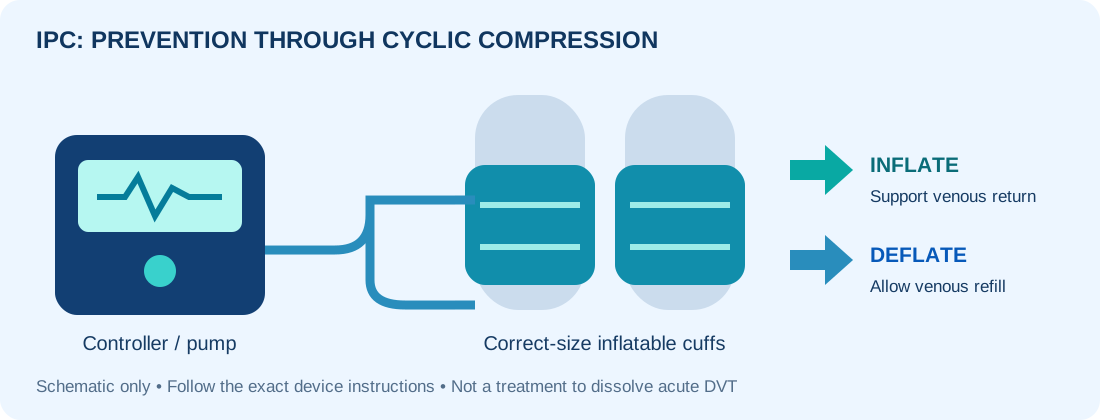
Concept diagram only. Actual cuffs, connections and settings depend on the model.
What each term means
Item
Function
Key distinction
IPC / SCD pump
Controller cycles air through compatible sleeves; some systems compress sequentially.
Reduces stasis; does not replace prescribed medicines.
Compresses the plantar venous plexus in compatible systems.
Different fitting, pressure and mobility precautions.
Anti-embolism / graduated stocking
Elastic, sustained graduated compression.
No pump; not interchangeable with IPC.
Pressure, inflation timing and sleeve position are device specific. Do not memorise one pressure as correct for all cuffs. Use the prescribed programme and exact manufacturer instructions. [4][5]
04
Indications & contraindications
When IPC may be ordered
Hospitalised patients with reduced mobility and assessed VTE risk.
Selected peri-operative, orthopaedic, trauma or immobile stroke patients under the relevant pathway.
When pharmacological prophylaxis is temporarily unsuitable because of bleeding risk, if IPC is itself suitable.
Alongside medicines when the risk-based plan calls for combined prevention.
Not every patient needs every method. Reassess when mobility, bleeding risk or condition changes. [4]
When to withhold / seek review
Known or suspected acute DVT, phlebitis or PE: routine prophylactic systems may be contraindicated.
Severe limb ischaemia / peripheral arterial disease.
Severe decompensated heart failure where increased venous return may be harmful.
Gangrene, vulnerable grafts, significant dermatitis or untreated infected wounds under the cuff.
These reflect example manufacturer exclusions; check the exact device. Fragile skin, neuropathy, major oedema or inability to report pain require extra assessment. [5]
Do not generalise “no compression” to all DVT care. Specialist-prescribed stockings/bandaging may relieve symptoms after assessment. They differ from a prophylactic pneumatic pump. Stockings are not routinely offered solely to prevent post-thrombotic syndrome. [14][17]
05
Nursing care for a patient on IPC
Before application
Verify identity, indication/order and device compatibility; explain the squeezing sensation.
Assess both limbs: skin, pain, swelling, colour, warmth, sensation and distal perfusion; identify exclusions.
Measure at the manufacturer’s specified points; choose prescribed sleeve length and size.
Inspect pump, cables, tubing, fasteners and alarms. Position the patient and protect lines/pressure points.
During use
Fit smoothly and securely without folds or continuous constriction; route tubing clear of skin and trip hazards.
Start the correct mode and observe complete inflation/deflation; verify no leaks, kinks or persistent alarms.
Remove sleeves regularly for skin/neurovascular assessment and hygiene as local policy requires; increase checks in vulnerable patients.
Minimise unnecessary time off; document interruptions and reapply promptly when appropriate. Assist mobility safely—disconnect/remove as instructed.
After / ongoing review
Record start/stop times, side, cuff type/size, checks, tolerance and escalation. Reassess the prophylaxis plan as mobility improves. Clean the pump according to instructions; do not reuse single-patient garments on another patient. Check replacement/transfer arrangements. [6]
Stop and assess: new pain, tingling, numbness, cold/pale foot, skin damage or new unilateral swelling. Persistent abnormal findings need urgent review; do not simply tighten the sleeve or silence alarms. [5]
06
Medicines: prophylaxis versus treatment
Anticoagulants reduce clot extension and new clot formation while the body clears clot over time; they are not the same as thrombolytic drugs. Preventive doses and therapeutic doses are different. Renal function, weight, liver disease, pregnancy, cancer, interactions and bleeding risk affect selection. [8]
Medication revision and nursing checks — administer only against a valid prescription
Medicine / group
Role
Nursing focus
Apixaban
Oral factor Xa inhibitor; adult DVT treatment uses an initial higher-dose phase then maintenance.
Check phase, adherence, kidney/liver status, interactions and bleeding. INR does not guide its routine dose. [9]
Rivaroxaban
Oral factor Xa inhibitor; initial twice-daily then once-daily adult treatment.
15 mg and 20 mg tablets require food. Do not use an atrial-fibrillation regimen as an automatic DVT regimen. [10]
LMWH, e.g. enoxaparin
Subcutaneous prophylaxis or therapeutic weight-based anticoagulation.
Check indication, weight, renal function and platelets. Use correct injection technique; do not rub the site. Anti-Xa monitoring is selective, not routine for everyone. [11]
Unfractionated heparin
IV therapeutic therapy in selected settings; SC prevention regimens also exist.
Check concentration, pump and local nomogram. Monitor aPTT/anti-Xa as ordered, haemoglobin and platelets. Watch for HIT. [12]
Warfarin
Vitamin K antagonist; selected long-term treatment.
Requires INR-guided dosing, interaction checks and consistent vitamin K intake. Initial acute-VTE treatment needs prescribed parenteral overlap; it is not immediately effective. [13]
Dabigatran / edoxaban
Other oral options in suitable patients, following an initial parenteral anticoagulant course.
Check renal suitability, sequence and interactions. [3]
Fondaparinux / non-heparin agents
Alternatives in selected situations.
Specialist selection is needed, particularly in renal impairment or suspected HIT. [8]
Thrombolysis / thrombectomy
Reserved for selected extensive or limb-threatening DVT; not routine.
Specialist pathway and close bleeding/neurovascular monitoring. An IVC filter is a selective option when anticoagulation is contraindicated, not a substitute for it in everyone. [15]
Adult treatment-dose revision examples (not a prescribing chart)
Apixaban: 10 mg orally twice daily for 7 days, then 5 mg twice daily in the standard adult DVT/PE regimen. [9]Rivaroxaban: 15 mg orally twice daily with food for 21 days, then 20 mg once daily with food in the standard adult DVT/PE regimen. [10]
These examples do not cover all contraindications, organ impairment, extended prevention or special populations. Check the locally authorised label and prescriber. Do not use these adult doses in children.
Contraindications & cautions to anticoagulation
Active major/pathological bleeding and relevant severe drug allergy are key contraindications. Recent major bleeding, intracranial disease, planned neuraxial procedures, renal/hepatic dysfunction or severe thrombocytopenia require urgent prescriber review. Suspected HIT requires withholding heparin products and immediate escalation under protocol. Pregnancy and high-risk antiphospholipid syndrome need a specialist regimen; do not assume a DOAC is suitable. [9][10][12]
No automatic “extra medicine”: aspirin, antibiotics and diuretics are not routinely added to treat an uncomplicated DVT. Prescribed analgesia may help; NSAIDs/aspirin increase bleeding risk when combined with anticoagulants unless specifically indicated. [9][15]
07
Nursing considerations for confirmed DVT
Assessment & inpatient care
Confirm investigation/treatment plan, allergies, weight, last anticoagulant dose and baseline blood results.
Trend pain, limb swelling, skin and neurovascular status using consistent measurement points when ordered.
Assess for PE, bleeding, falling haemoglobin and haemodynamic change; escalate promptly.
Check CBC/platelets, renal/liver function and ordered coagulation tests; match monitoring to the actual medicine.
Support prescribed mobilisation once appropriately anticoagulated and clinically stable; no blanket prolonged bed rest. Coordinate with the clinician/physiotherapist.
Elevate the leg when resting if suitable, give prescribed analgesia and respect fluid restrictions. Avoid calf massage.
Duration is individualised. Confirmed proximal DVT commonly needs at least 3 months of anticoagulation; reassess recurrence and bleeding risks before stopping/continuing. Distal DVT, cancer-associated thrombosis and pregnancy may follow different plans. [3]
Acute DVT suspected? Review before routine prophylactic pump use.
UFH: aPTT/anti-Xa per protocol; warfarin: INR; DOAC: no routine INR dose titration.
New dyspnoea/chest pain: urgent PE assessment; bleeding/head injury: urgent anticoagulant review.
09
16 scenario MCQs
Original practice questions. Choose an option, then review the rationale. You can retry or print the answer key.
0 / 16 answered
01. A post-operative patient has unilateral calf swelling before IPC is started. What is the priority?
Correct answer: B. New symptoms require review. Routine prophylactic IPC must not be applied reflexively to a limb with suspected acute DVT.
02. The main action of a DVT-prevention pump is to:
Correct answer: B. Inflation and deflation support venous return; IPC does not chemically dissolve an existing clot.
03. Which patient requires review before routine IPC?
Correct answer: C. Severe ischaemic arterial disease is a common manufacturer contraindication to prophylactic IPC.
04. A patient reports numbness and a cold foot under an IPC sleeve. The nurse should:
Correct answer: C. Neurovascular symptoms need immediate assessment, not more compression.
05. Which pressure is correct for every DVT pump?
Correct answer: D. Pressure and cycle depend on the pump, garment and prescription. Follow the exact device instructions.
06. Which finding in a patient with DVT needs an emergency response?
Correct answer: B. This may indicate PE. Activate urgent assessment and support ABCs.
07. A positive D-dimer by itself:
Correct answer: C. D-dimer is not specific enough to diagnose DVT in isolation.
08. Which test commonly guides warfarin dosing?
Correct answer: A. Warfarin is titrated to an indication-specific INR target; routine INR titration does not apply to DOACs.
09. Platelets fall substantially and new thrombosis develops during heparin therapy. Priority?
Correct answer: B. HIT is prothrombotic and can occur without bleeding; urgent review and a non-heparin plan may be needed.
10. What is essential for rivaroxaban 15 mg and 20 mg tablets?
Correct answer: A. These strengths require food for reliable exposure; follow the prescribed regimen and label.
11. Which statement about mobility after DVT is best?
Correct answer: B. Activity is individualised; stable treated DVT does not imply blanket prolonged immobilisation.
12. Which is correct about stockings after DVT?
Correct answer: C. Stockings and IPC are different. Routine stockings solely to prevent PTS are not recommended by ASH.
13. Prophylactic and therapeutic enoxaparin regimens are:
Correct answer: C. A prevention dose must not be assumed to treat an established clot.
14. An anticoagulated patient has a head injury and a severe headache. Action?
Correct answer: B. Intracranial bleeding must be considered; urgent assessment is required.
15. When symptoms improve, the patient should:
Correct answer: B. Symptom improvement does not establish a safe stopping point.
16. Which bedside action reliably excludes DVT?
Correct answer: C. DVT can be asymptomatic; provocative signs and appearance alone cannot exclude it.
View / print full answer key
B. New symptoms require review. Routine prophylactic IPC must not be applied reflexively to a limb with suspected acute DVT.
B. Inflation and deflation support venous return; IPC does not chemically dissolve an existing clot.
C. Severe ischaemic arterial disease is a common manufacturer contraindication to prophylactic IPC.
C. Neurovascular symptoms need immediate assessment, not more compression.
D. Pressure and cycle depend on the pump, garment and prescription. Follow the exact device instructions.
B. This may indicate PE. Activate urgent assessment and support ABCs.
C. D-dimer is not specific enough to diagnose DVT in isolation.
A. Warfarin is titrated to an indication-specific INR target; routine INR titration does not apply to DOACs.
B. HIT is prothrombotic and can occur without bleeding; urgent review and a non-heparin plan may be needed.
A. These strengths require food for reliable exposure; follow the prescribed regimen and label.
B. Activity is individualised; stable treated DVT does not imply blanket prolonged immobilisation.
C. Stockings and IPC are different. Routine stockings solely to prevent PTS are not recommended by ASH.
C. A prevention dose must not be assumed to treat an established clot.
B. Intracranial bleeding must be considered; urgent assessment is required.
B. Symptom improvement does not establish a safe stopping point.
C. DVT can be asymptomatic; provocative signs and appearance alone cannot exclude it.
10
References & scope
Adult nursing education; not an individual prescription or a model-specific operating manual. Device instructions and local clinical pathways take precedence. Paediatric and pregnancy care require their own protocols. References reviewed 31 October 2026.
Original revision text, schematic illustrations and MCQs prepared for Nursing Medium. No manufacturer diagrams, product photos or guideline tables reproduced.
 Nursing Medium